
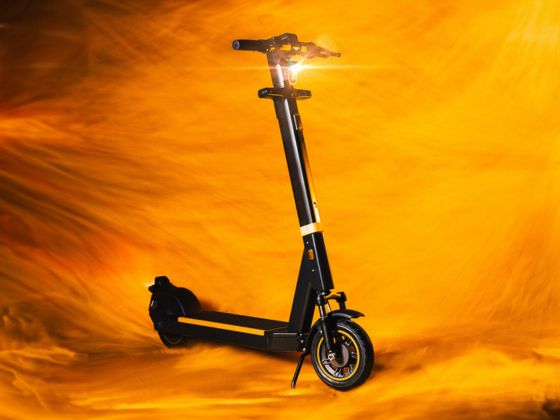





A legal e-scooter costs roughly €250 to €350 per year in the Netherlands in ongoing costs, plus depreciation on the purchase. That's less than most people think — and far less than almost any alternative except a regular bicycle. But the math works differently than with a car, and the biggest expense isn't the one you'd expect.
Last updated: July 2026. All amounts are indicative and intended to show proportions. Third-party prices change; check them with the provider before making a decision.
First: the assumptions
Every cost calculation stands or falls with what you put into it. We calculate with:
- A registration-required, RDW-approved e-scooter in the special moped category
- Purchase price €1,900 (the price at which the SELANA Alpha starts)
- 1,500 kilometers per year — about 15 kilometers round trip per workday, or a daily commute of 3.5 kilometers
- A usage period of five years
- Electricity price €0.30 per kWh
If you ride more, variable costs go up but the cost per kilometer drops considerably. If you ride less, depreciation dominates and the scooter becomes expensive per kilometer. That applies to every vehicle.
One-time costs
| Item | Amount | Explanation |
|---|---|---|
| Purchase | from €1,900 | Legal, approved model |
| Registration | €0 with type approval | With a model that has national type approval, the supplier arranges this |
| License plate | approx. €15 – €25 | From a recognized plate manufacturer |
| Lock | €40 – €120 | Often a requirement from your insurer |
| Helmet (optional) | €40 – €100 | Not mandatory, but advisable |
If you buy an unregistered second-hand model that was already approved before July 1, 2025, the individual RDW assessment comes on top of that. This has become considerably more expensive since the transition scheme expired — see our article about the deadline of July 1, 2026 and check the current rate on the RDW rates page.
Annual costs
| Item | Per year | Explanation |
|---|---|---|
| Third-party liability insurance | approx. €70 – €150 | Mandatory. Comprehensive coverage costs more |
| Electricity | approx. €7 | 1,500 km at approx. 1.5 kWh per 100 km |
| Maintenance, tires, brake pads | approx. €50 – €100 | Highly dependent on usage and road surface |
| Battery replacement reserve | approx. €100 | A battery lasts several years; reserve in advance |
| Motor vehicle tax | €0 | Mopeds are exempt |
| Vehicle inspection (APK) | €0 | No inspection requirement for this category |
| Total ongoing | approx. €230 – €360 |
That seven-euro electricity bill is not a typo. An e-scooter battery is small — an order of magnitude smaller than that of an electric car. Even with daily charging, you'll barely exceed ten euros a year. Anyone who buys an e-scooter to save on energy costs is, in practice, saving on something else: parking, fuel, or a second car.
The biggest expense is depreciation
This is where most cost calculations online silently go wrong. They add up insurance and electricity, arrive at fifteen euros a month, and leave the purchase out of consideration. That's not how it works.
If you assume a €1,900 purchase, five years of use, and a residual value of roughly €400, you depreciate €300 per year. That's more than all ongoing costs combined. The real total costs thus come to roughly €530 to €660 per year, or €45 to €55 per month.
At 1,500 kilometers per year, that's about €0.38 per kilometer. If you ride 3,000 kilometers, the fixed costs per kilometer are halved and you're around €0.21. This is the core message of every cost calculation for electric transport: the costs lie in ownership, not in driving. The more you ride, the cheaper every trip becomes.
How does that compare to the alternatives?
The car
A car doesn't lose this comparison by a little but by miles. Depreciation, insurance, motor vehicle tax, fuel or electricity, maintenance, inspection, and parking add up for a small car to several hundred euros per month — a multiple of the e-scooter, even at modest mileages. If you want to calculate your own situation precisely, use the ANWB car cost calculator instead of an average from a blog.
The honest caveat: an e-scooter rarely replaces an entire car. It often does replace the second car, or the daily trips for which you now take the car out. That's where the money is — and in cities where a parking permit already costs more than the entire e-scooter per year, it counts double.
Public transport
Here the comparison is more interesting, because the e-scooter usually doesn't compete with the train itself but with the stretch before and after it.
If, on the other hand, you rent an OV-fiets every workday, that adds up: at about 220 workdays and the current rate of €4.80 per rental, you reach more than a thousand euros a year. An e-scooter that you simply take on the train — free, even during rush hour, see our article on e-scooters on train, tram, and metro — pays for itself in that scenario in about two years, and after that you ride almost for free for years.
If you instead take your bicycle on the train, you need a Fietskaart of €8.50 outside off-peak hours. An e-scooter counts as hand luggage and doesn't need one.
The e-bike
Financially, e-scooter and e-bike are closer than people expect. A decent e-bike costs €2,000 to €3,000, insurance is comparable or higher due to theft risk, and maintenance is more expensive because there's more to it: chain, gears, more brake work. Against that stands a longer lifespan. The difference isn't in the euros but in the question of which vehicle suits your trip — we wrote a separate comparison for commuting about that.
The shared scooter
For anyone making the same trip daily, sharing is the most expensive option of all: a commuter quickly ends up at more than a hundred euros a month. The full break-even calculation is in e-scooter or shared scooter: when does buying become cheaper?.
The tax route: what you don't have to pay yourself
If you use the scooter for commuting, the math changes considerably.
Your employer may reimburse €0.25 per business kilometer tax-free. That rate was raised in 2026 from €0.23 and applies retroactively to January 1, 2026. At 1,500 kilometers per year, that's €375 tax-free — more than the entire annual cost item. With a serious commuting distance, the mileage reimbursement effectively covers the scooter entirely.
In addition, the scooter can run through the free space of the work-related costs scheme or through an existing bicycle plan. Exactly how that works, and where the line lies between a bicycle plan and a special moped, is described in company e-scooter: does it fall under the bicycle plan?.
When an e-scooter is not a financially sensible choice
We sell them, but that doesn't mean it's always the cheapest solution. Don't kid yourself either way:
- You ride less than a few hundred kilometers per year. Then you mainly pay depreciation and insurance for a vehicle that sits still. Renting or borrowing is then wiser.
- You already have a good bicycle and your trips are short and flat. A regular bicycle costs almost nothing and is often just as fast for short distances.
- You almost always travel with more people or a lot of luggage. Then the car or public transport remains the realistic option and the scooter is only added on top.
- You don't have a safe place to park it. Theft risk is a real cost item, even if it doesn't appear on your annual accounts.
Frequently asked questions
Do I pay road tax on an e-scooter?
No. Mopeds — and thus also special mopeds — are exempt from motor vehicle tax. A vehicle inspection (APK) doesn't apply either.
How long does the battery last?
Lithium-ion batteries gradually lose capacity; the number of charge cycles and the charging method determine how fast. Expect several years of normal use, not forever. So reserve an amount annually for replacement instead of being caught by surprise all at once. When purchasing, always ask whether batteries will still be available in a few years — that's one of the key differences between brands.
Is insurance more expensive than for a bicycle?
For an e-scooter, third-party liability insurance is legally mandatory; for a regular bicycle it's not. That's the real difference. The premium itself is modest, but it's there every year. What exactly is covered and what to watch out for is in our guide on insuring an e-scooter.
What happens to the residual value now that there are license plates?
A second-hand e-scooter with a valid license plate is demonstrably worth more than one without, because otherwise the buyer has to arrange that registration themselves at a hefty rate. The registration requirement thus actually depresses the residual value of unapproved models — those are simply unusable on public roads.
Can I lease an e-scooter instead of buying one?
Yes, that can be interesting because you shift the depreciation and maintenance risk to the leasing company. Check the options on our lease page.
Conclusion
Expect about €45 to €55 per month for everything combined, of which the largest part is depreciation and not usage. That's more expensive than a bicycle, roughly comparable to an e-bike, considerably cheaper than daily shared mobility, and not in the same order of magnitude as a car.
If you use it for commuting, the tax-free mileage reimbursement of €0.25 eliminates a significant part — sometimes all — of those costs.
Want to see if it works for your situation? Schedule a test ride or check out the SELANA Alpha.
Practical: e-scootering in daily life
- E-scooter or shared scooter: when does buying become cheaper?
- E-scooter as an alternative to the mobility scooter
- E-scooter and alcohol: what's the legal limit?
- Taking your Dutch e-scooter abroad
- Taking an e-scooter on the train, tram, and metro
More about the rules: e-scooter rules 2026, all RDW-approved models, and buying a legal e-scooter.


