
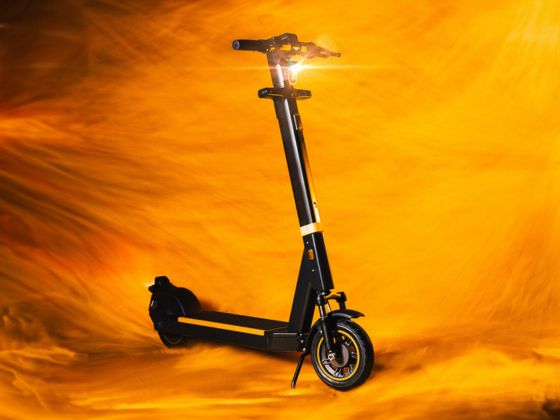





Short answer: no, an e-step does not fall under the bike plan. The bike scheme with 7% addition to taxable income applies to bicycles, e-bikes and pedelecs — not to an electric scooter, because that is not fiscally a bicycle. But that doesn't mean your employer can do nothing. There are four routes that do work in 2026, and two of them are more tax-favorable than the bike plan.
Last updated: July 2026. Sources: Belastingdienst and Rijksoverheid. This article is general information, not tax advice — discuss your situation with your accountant.
Why the bike plan doesn't work for an e-step
The Belastingdienst explicitly describes the scope of the bike scheme: "bicycle" also includes an electric bicycle, a lease bicycle and a pedelec. If you get such a bicycle from your employer and are allowed to use it privately, your employer adds 7% of the recommended retail price to your salary.
A stand-up electric scooter has no pedals and doesn't move forward by muscle power. Legally it is a special moped, its own category in the Road Traffic Act with its own requirements: license plate, third-party liability insurance, minimum age 16. Fiscally, the treatment follows that classification: not a bicycle, so no bike scheme.
That's not necessarily bad news. The 7% addition is a cost for the employee. The routes below can work out cheaper.
Route 1: the work-related costs scheme (free space)
For most employers this is the simplest route. Within the work-related costs scheme, your employer may give tax-free reimbursements and provisions to staff, up to a certain percentage of the fiscal wage bill. In 2026 that is 2% on the first €400,000 and 1.18% on the remainder.
An e-step of €1,900 comfortably fits within that for most employers. The employee pays nothing, there is no addition to taxable income, and the scooter is simply their property.
Two points to note. The free space is finite and is often already used for Christmas hampers, staff parties and bonuses — so check what's left. And there is a "customariness test": the provision may not deviate unusually much from what is normal in comparable situations. For a commuting vehicle that's rarely a problem.
Route 2: tax-free mileage allowance of €0.25
The tax-free travel allowance was increased from €0.23 to €0.25 per kilometer as of January 1, 2026. Crucial detail: that allowance applies to all modes of transport. Car, motorbike, bicycle, on foot — and therefore also an e-step.
Do the math. If you live 12 kilometers from the office and go four days a week, that's 96 kilometers per week round trip. Over 46 working weeks that comes to more than 4,400 kilometers, or about €1,100 per year tax-free. The scooter pays for itself in less than two years, while your energy costs are a few euros per month.
This route can be combined with route 1: the employer provides the scooter from the free space AND pays the mileage allowance.
Route 3: the scooter remains company property
The employer buys the scooter and makes it available, just like a company car. The scooter remains the property of the company. For private use there is no fixed addition percentage here as with cars or bicycles; the value of private use is determined based on actual value. In practice, for a vehicle used almost exclusively for commuting, that is a modest amount.
This route is administratively heavier than route 1 and is mainly interesting for larger numbers — a fleet for a service department, delivery, or a business campus. We work with partners for this for business leasing.
Route 4: buying it yourself as an entrepreneur or freelancer
If you are self-employed, you simply buy the scooter as a business expense. The purchase goes on the balance sheet, you depreciate it, and VAT is reclaimable for the business portion. If you also use it privately, you correct proportionally.
Note the small-scale investment deduction (KIA): in 2026 that only starts at a total investment of €2,901 per year. A single scooter of €1,900 doesn't reach that threshold, but does count if you also purchase other business assets in the same year. If you exceed the threshold, the deduction is 28% of the investment amount.
The four routes side by side
| Route | Cost to employee | Ownership | Best for |
|---|---|---|---|
| Work-related costs scheme | None | Employee | Individual employees, quick to arrange |
| Mileage allowance €0.25 | None (earns money) | Employee | Anyone with a commute |
| Company scooter | Addition based on actual value | Employer | Fleets and business use |
| Buying as a business (entrepreneur) | N/A | Business | Freelancers and directors/major shareholders |
What your employer needs to know
Three things HR and mobility managers often ask:
- Liability. An e-step requires a license plate and third-party liability insurance. Make sure the policy is in order before the first ride — see our guide to insuring an e-step.
- Legality. Only RDW-approved models are allowed on the road. Providing an unapproved scooter to staff is a risk you don't want to take as an employer.
- Parking and charging. A scooter takes up a fraction of the space of a car and charges on a regular outlet. For offices with parking pressure that's often the deciding argument.
Frequently asked questions
Can my employer exchange the e-step for gross salary via the cafeteria model?
Yes, but it then falls under the work-related costs scheme and comes out of the free space. Discuss with payroll how this is processed in the filing.
Does the €0.25 also apply if the employer has already paid for the scooter?
If the employee owns the vehicle, yes. Not for a company scooter — then the costs are already borne by the employer.
Will the bike scheme still change in favor of e-steps?
Nothing has been announced about this at this time. The clarifications in the 2026 Tax Plan concerned shared bicycles and the storage condition, not an extension to special mopeds.
May an employer also provide a second-hand e-step?
Yes, provided the model is RDW-approved and the license plate is correctly transferred.
Conclusion
The bike plan isn't the route — but the work-related costs scheme and the increased mileage allowance of €0.25 are, and for the employee these often work out more favorably than a 7% addition. Check out the business options or check out the SELANA Alpha.


